 Vimeo recently announced its plan to overhaul the video-sharing site. For users and creators looking for an alternative to the glut of YouTube, Vimeo offers a more elegant solution to sharing video content online. The company plans to incorporate new functionalities to improve the Vimeo experience.
Expect to find:
- New video page
- Improved search
- Better video browser
- Streaming feed
- Follow
- Multiple file uploading
- Better privacy control
- Recently viewed videos
- Related videos
Read more at PCMag.com
Vimeo Plans Full Site Overhaul
Social media has changed how educators engage with each other and their students online. Recently, BestCollegesOnline.com compiled a list of the “50 Teachers Who Are Social Media Stars.” You may already be familiar with some of these names:
More importantly social media is being used to eliminate barriers to learning–from preschoolers using iPad apps, to professionals climbing the corporate ladder. Recently the New York Times reported on how the Kahn Academy is using YouTube to teach math and science to high schoolers, while global organizations like Deloitte are using Yammer to create an internal social network enabling employees to share and connect.
In the past year eLearn Magazine has published a range of articles that tackle the issue of utilizing and managing social media in the online learning space:
What about you? How are you utilizing Twitter, YouTube, Facebook, Google , Tumblr, and Slideshare? Are you blogging?
If you’ve answered yes, then keep it up! You may be on next year’s list. If not, there’s no better time than the present.
 LoudCloud has launched a mobile version of LoudCloud University Suite, its proprietary LMS for higher education. The app, developed for a growing contingent of iPad users, enables users to download, annotate, and read course materials offline. Students can access their course information on the go.
LoudCloud, as you may have guessed, is a cloud based solution. It was launched in 2010 as an alternative to the traditional LMS. You can find out more about LoudCloud and its offerings next week during a webinar scheduled for December 15, 2011 at 11:00am PST. Register for free or request a demo of LoudCloud University Suite.
Link: The full press release is online.
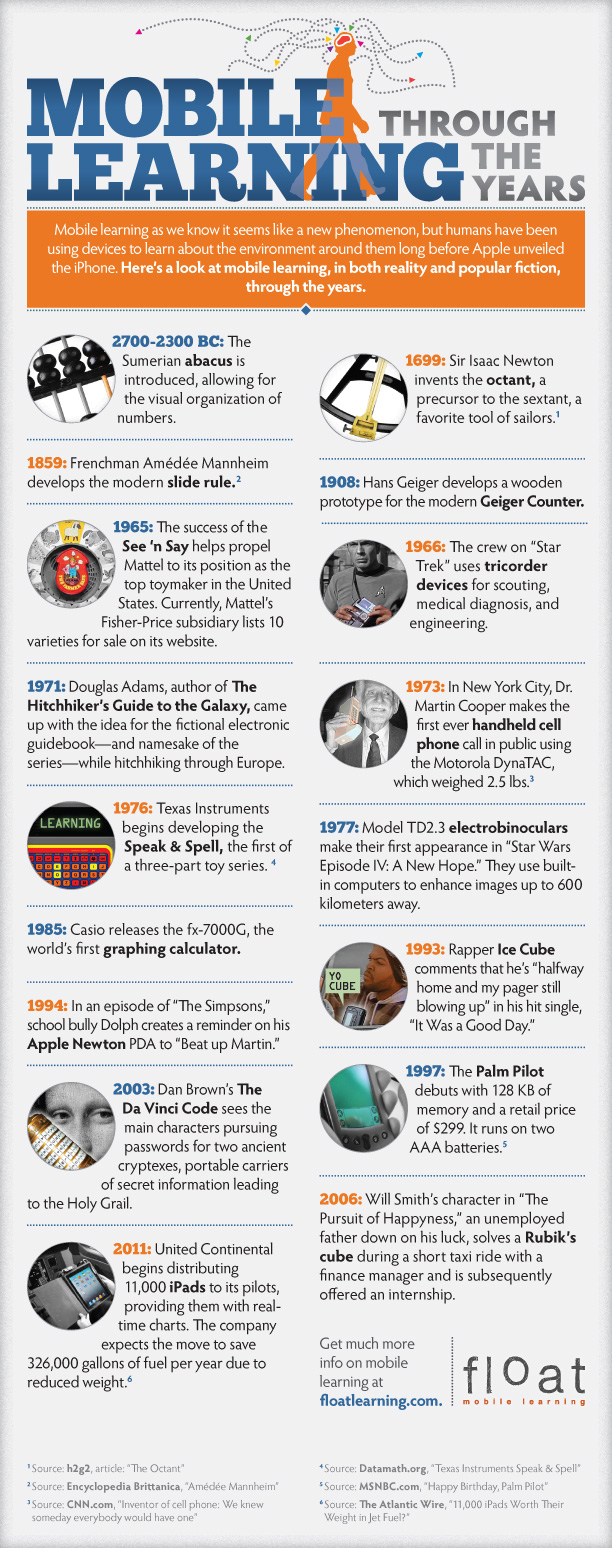
Coinciding with Allison Rossett’s most recent article on mobile learning, earlier today I came across an insightful yet humorous infographic created by Float Mobile Learning.
The abacus, See ‘n Say and Rubik’s Cube were all learning tools I loved as a child. Something a parent could throw in their bag and pull out for an impromptu lesson. Now we have smart phones, iPads and Kindles. Yet there still seems to be a disconnect between these innovative tools and their usefulness for learning at an organizational level. Allison attempts to answer the question: If mobile learning and support are wonderful, why aren’t they everywhere? Take a look at the “history of mobile learning” below.
This post, to me, is really about what Mark Federman has called “unanticipated consequences” or “unintended consequences.” (Federman is Chief Strategist at the McLuhan Program in Culture and Technology so his statements are informed by Marshall McLuhan’s “the medium is the message” paradox.) It’s a good read. Anyway the post I’m referring to here is Audrey Walter’s interview of Terence Craig, co-author of “Privacy and Big Data.” As our channels for learning become more digitally dispersed, one has to wonder how that data will eventually be used. While Craig is talking about consumer privacy, the same issue exists internally at organizations. Ultimately it’s about transparency. Are you creating an environment where employees trust? Trust goes a long way in creating a safe environment for online learning.
What Does Privacy Mean in an Age of Big Data? Audrey Walters, November 2, 2011
 Vimeo recently announced its plan to overhaul the video-sharing site. For users and creators looking for an alternative to the glut of YouTube, Vimeo offers a more elegant solution to sharing video content online. The company plans to incorporate new functionalities to improve the Vimeo experience.
