Converge Magazine reported that the World Future Society predicted that one of the ten breakthrough technologies that “will transform life as we currently know it” is distance education. I was amused because (1) it has already transformed so many people’s lives and (2) most people no longer call it “distance education”.
In the article, Roger Schank said that not much has changed in the past fifty years. His vision is that students should be put in simulated environments where they can learn by doing, rather than memorizing facts and formulas, and believes that few education leaders and politicians are visionary enough to make sweeping changes.
While I agree about the lack of sweeping changes, I disagree about the role of memorization and the lack of change. Memorization is essential, but it needs to be coupled with learning how to apply facts and formulas in meaningful ways. Medical students, to pick on a discipline where memorization is crucial, can not just “learn by doing”. And the change is evident in every aspect of education, although one can certainly argue not all change is for the better. This sentiment was expressed last week at the Health 2.0 conference, where Esther Dyson said “we should be paying for health, not for health care, and we should take $5 billion and train more gym teachers.”
Back to the future – I mean back to my points. Distance learning and educational technology has certainly transformed education but there is room for more change. And what we call it matters: e-learning, online learning, etc. are the more au courant terms. When I read about distance learning, it reminds me of correspondence schools. And even one of the few remaining correspondence schools recently changed its name. The International Correspondence School is now Penn Foster. Started in 1890 by newspaperman Thomas Foster, the initial goal was to help anthracite coal miners become mine superintendents and foremen, studying over candlelight following a 12-hour shift. Talk about people who would have been better off in simulated environments!
The glow of technological devices has replaced candlelight, email has supplanted postal mail, and the e-learning of today is not just lessons placed online but uses innovative technologies to engage learners. The classroom has not been replaced because it serves an important role, as Saul Carliner eloquently articulated in the controversial Long Live Instructor-Led Learning. I wonder what the World Future Society has to say about that.
The World Future Society, interesting, does have something to say about pandemics. An article about the Threat of a flu pandemic, from a 2006 issue of their magazine, was just updated to say that the initial carriers were birds rather than pigs but that the article “still provide[s] a reliable picture of what government response to a pandemic might entail”. While Stephen Downes might have a field day reviewing and grading their past predictions, this article seems quite accurate although not a prediction per se.
No one will argue that predicting the future is hard, Jeane Dixon notwithstanding. But, using the right terminology makes it easier to look to the future.
Back to the Future: Distance Learning, Correspondence Schools, and Pandemics
Learning from Renowned Chefs
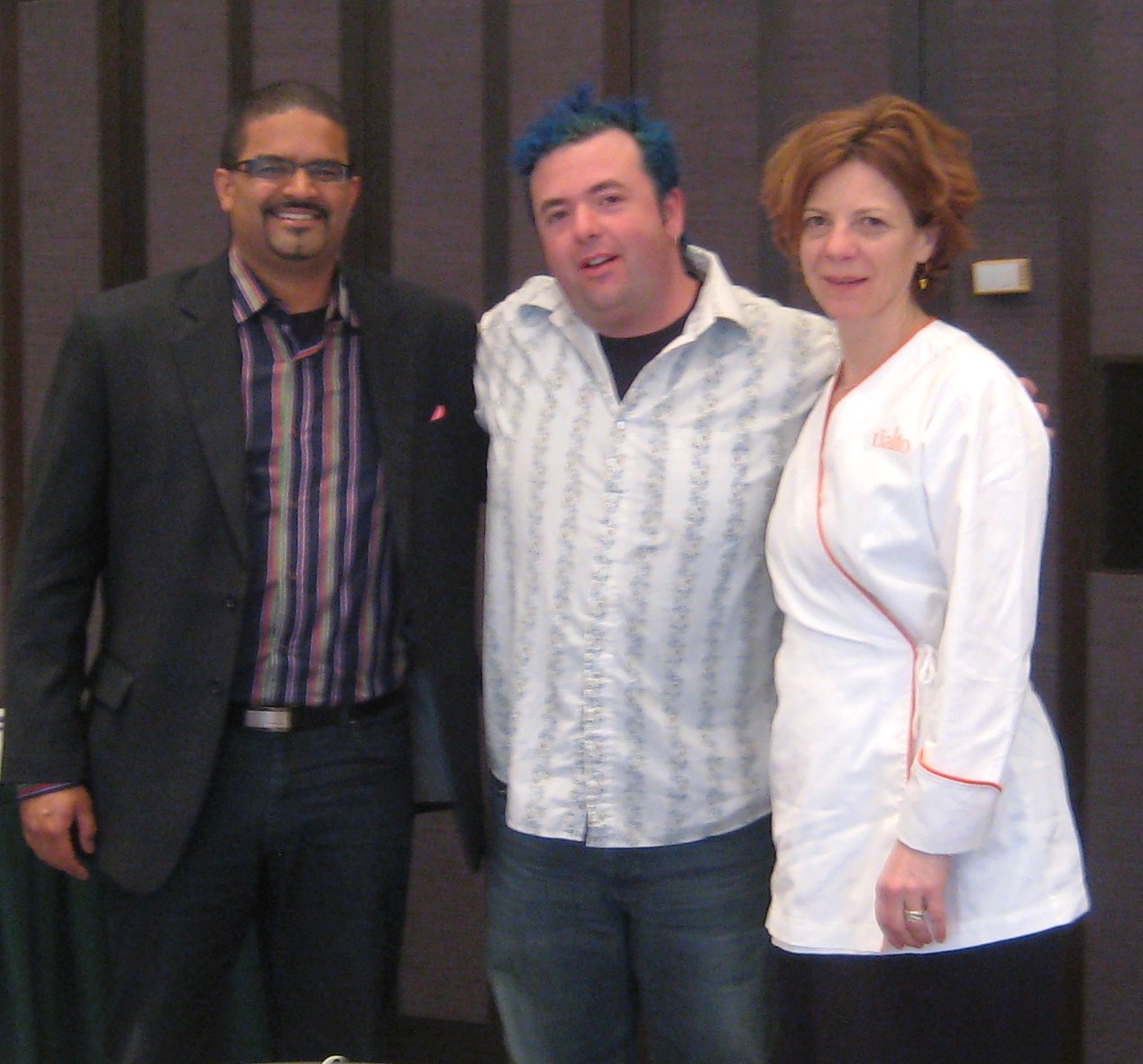 “Taste, taste, taste,” was the advice of Chef Jody Adams from the Rialto Restaurant in Cambridge, MA. And “know who your customers are”. When was the last time you did the e-learning equivalent and sampled one of your own courses or checked in with your students?
Jody and Chef Jason Santos, Gargoyles Restaurant, were the two renowned chefs on the panel What Can User Experience Learn from Food Design at CHI 2009 organized by Patanjali Venkatacharya, Oracle Corporation.
What impressed me most about Jody and Jason’s descriptions of what they do is the attention to detail and the incredible project management skills needed to run a successful restaurant. They both spoke of the endless sources for their inspiration and how they keep pads of paper everyplace to jot down ideas. Having eaten at both restaurants, I can attest to the success of their creativity, the attention to detail, and the delicious results.
I was interested in the discussion about ratings and reviews, especially when Jody described telling her mother and her mother’s friends about the anonymous reviews they receive online. Their reaction: “Why that’s rude”.
As press, I spoke to both following the panel and asked, of course, if it is possible to learn to cook online. Jason’s immediate response was that it was “impossible” and “the silliest thing he had heard in his life.” In the ensuing discussion, Jody said that cooking shows can help provide an affinity for food and cooking and are entertaining as well. Jason clarified that knowledge can be acquired online but not techniques, but went on to say that Julia Child inspired him. As he warmed to the topic, Jason amended his earlier statements to say that learning to cook is multi-sensory and, even with a webcam, one needs an instructor to taste and adjust the salt, to which Jody agreed. We concluded the interview with a discussion of the impact of food scares and recalls on their menus and about cities that require restaurants to provide calorie or nutritional information. Jody and Jason talked about how some chefs are cream- and butter-driven and Jody concluded the interview with, “I love butter.” Maybe we can all take a lesson from them and make our next courses richer.
Perishable Learning
 Recently I learned how to put together a memorial service and how to make cotton candy. The former was for the sad occasion of my father’s death and the latter was for my daughter’s elementary school fair. The commonalities are that, in both cases, assistance came from more experienced individuals, my knowledge sufficed for the occasions but had neither depth nor breadth, and the knowledge and skills are perishable in that they are unlikely to be used again.
What does it mean for learning to be perishable? Certainly, there is little difference between the process for acquiring perishable or more permanent learning because some degree of mastery is required: A memorial service needs to go smoothly and eager children must not be disappointed. I think what perishable learning ultimately means is that blinders go on.
In the case of the memorial service, I had little curiosity about the the psalms we chose or the reasoning behind order of events although my understanding of the mourning process is more comprehensive due to expert guidance. And, knowing that I may never make cotton candy again, I was less curious than I otherwise would have been about how the machine worked or the composition of the vibrantly colored powder, but may retain the optimal flick of the wrist that I mastered after a few tries.
Were these pursuits that would be repeated, I would have had far more questions. The answers could have led to new questions. Perishable learning is pervasive because of the multitude of situations that arise when one uses software once for a project or rents a car without bothering to master the bells and whistles. Perishable learning, therefore, is not merely learning that is discarded in the same way perishable foods are discarded after their time, but learning that does not invoke further pursuits and tangents.
Can the Best of Informal Learning Simultaneously Be the Worst Thing for Cognitive Processes?
 It struck me recently that mobile learning (or m-learning) is no longer a discipline within e-learning because of the ubiquity, enhanced screen size, and improved display quality of mobile devices. Remember when it was worthy of a press release when a medical or law school decided to require the use of mobile devices? No more. The question now seems to be when can they be used and when students are asked to turn them off or drop them in a bin as entering the classroom. Of course, the lack of presence in an online classroom has always meant that, pajamas and bunny slippers notwithstanding, it is possible for students to use all sorts of devices without a teacher typically knowing where students’ attention was focused.
The adoption and use of Internet-enabled mobile devices facilitates easy retrieval of information. Many people look up information at the slightest provocation. Who sang the song with the lyrics, “Let me see what spring is like on Jupiter and Mars”? (Answer: Frank Sinatra.) In which year was Ceylon renamed Sri Lanka? (Answer: 1972 and officially it is called the Democratic Socialist Republic of Sri Lanka.) But in the process of answering questions so easily and quickly, there is no time for happy memories of dancing to Frank Sinatra at the Rainbow Room or humming the song through to see if the singer comes to mind. Similarly with Sri Lanka and other queries: there is no time for the association games we all play, often with pleasure and occasionally with frustration when the answer is on “the tip of your tongue“.
While mobile technologies provide excellent “Cognitive Prosthetic Devices” in the sense that they reduce the burden of recall, they reduce the pleasure of recall and may impair cognitive processes as a result. Exploring memories and challenging myself to remember things I learned may (if you’ll excuse another idiom since I was just searching for them), go the way of the buffalo. Convenient informal learning through mobile devices is fun too, since often when I do a search I learn new things, either tangential or relevant. Perhaps what ultimately matters is finding the right mix and the appropriate timing; and the classroom may be only a marginally better place for instant access than the dinner table.
Professionals Use Searches to Locate Graduate Programs
 Not only has technology “dramatically changed the way students experience university life,” according to The Guardian, it has impacted how they learn about schools. College selection has progressed far beyond browsing college catalogs in the library, although the many online (web) and offline (college coach) methods primarily target high school seniors. How, then do early- and mid-career professionals find graduate programs? Not surprisingly, through searches.
I have been thinking about this because of two experiences. This first was a program review and technology evaluation for Goucher College’s Master of Arts in Historic Preservation. Students and alumni, when asked how they heard about the program, mentioned searches and word-of-mouth. In the former case, many stumbled upon the program after multiple searches because their initial search terms were not “Master of Arts in Historic Preservation”. One of the recommendations the program review committee made was to determine what are the terms current students used to find the program and make sure through a combination of techniques that these terms actually led to the Historic Preservation program website.
Then, I started helping the Tufts University School of Medicine Pain Research, Education, and Policy (PREP) program promote their program using social marketing techniques. Not surprisingly, they have a similar situation: students primarily find out about the PREP master’s degree online. This time, my recommendations, in a detailed proposal, led to funding for a PREP student, Pam Ressler, and a series of meetings, including one with students, alumni, and faculty providing ideas about the types of students who might be interested in the program and the search terms they might use to find it.
To date we have launched a blog about pain. The initial entries include data about the disturbingly high number of people who are in pain (26% of Americans reported being in pain for more than 24 hours during the prior month) and the provocatively titled, “Is Pain a Symptom or a Disease?” Pam, as community manager, has student, alumni, and faculty commitments to write new posts, since blogs, especially group blogs, rarely manage themselves and the quickest way to lose a visitor is for the most recent post to be 6+ months old.
If you think the PREP blog was a good idea, I will only take partial credit since one of my sources of inspiration was the U Mass Online blog, which is also a group blog that brings in multiple perspectives. I don’t know how successful it has been at attracting new students but I would imagine that someone considering the program would likely be influenced positively by their posts.
Blogs are a great way to come up in a search. I blogged one of the last articles I wrote, “Dr. Google: Your Patients, the Internet, and You“, and, when I search on it, not using quotes, my blog entry comes up first in Google.
If your prospective students are online, they are likely to be doing searches, one of the most popular online activities. Blogs are a great way to attract their attention. There are other initiatives we have planned and I’ll write about those once we implement them.