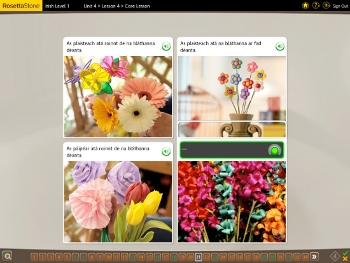
 Last week a rep from RosettaStone showed me a demo of the company's newest product called Totale, which officially launches today.
If you've ever used RosettaStone (or stopped at one of their kiosks in a shopping mall for a product demo of your own), you already know that it's language-learning software that goes beyond audio CDs by incorporating visuals, speech recognition, and spelling, all of which reportedly enhances one's ability to learn.
What's new about Totale is it takes the entire RosettaStone package, moves it online, and adds two whole new pieces, making three in all: 1) Course (the classic RosettaStone), 2) Studio, and 3) World.
Studio may be the most interesting component for readers of this site, as it is essentially an online class. An instructor, or "coach," as RosettaStone's Chris Spiller corrected me, conducts a 50-minute online class for up to four learners, which are held at all different times of day. A learner logs on and joins the session with the other learners and one coach, who operates entirely in the language being learned. (Support staff are available in one's native language to assist with technical issues.) The lesson that the coach works through is supposed to align very closely with whatever Course unit the learner has just finished, so for example, if you've been learning the numbers, animals, and colors, that's exactly what you'll be working on in the Studio.
All the coaches (58 have been hired so far) are native speakers of the language they teach, and most work from home.
I like the idea of a person deciphering my mangled French rather than a computer with speech recognition, which I have failed miserably in the past. Getting machines to handle anything linguistic, from translation to language-generation, is monumentally difficult, so it only makes sense to include real live human beings in the process.
The third component, RosettaStone World, leaves the coaches behind and connects learners to one another, where they can interact in web pages and using VOIP. The emphasis in World is play, so RosettaStone has developed some low-key games, mostly of the matching variety.
The launch price is $999 for a 12-month subscription to the whole service, and there's no upgrade price for people who already own the DVDs (a shame if you ask me). Because the product has been in beta for a few months, there are already a number of other language learners in World and Studio ready for new subscribers to join their online language party.
I think the most difficult hurdle for consumers, or "learners," is that all you get for a thousand bucks is the ability to learn—no books, no degree or certificate, just the opportunity to listen, speak, play, and practice. It's a dilemma that nearly all online learning providers—as well as providers of other digitally distributed media—have to contend with. What is the actual value of learning, and what are people willing to pay for it?
—Jill Duffy, Senior Editor
RosettaStone Launches Totale
Why Would a Nurse Get a PhD and Does the Degree-Granting Institution Matter?
I receive many press releases and often skim them to learn about new initiatives. I tend to ignore the ones about staffing changes within companies; I also rarely read the quotes that I always suspect are written by marketing but attributed to executives within the company.
This morning I received notice that the “University of Phoenix Expands Advanced Degree Programs; Adds Ph.D. in Nursing and Educational Specialist Degrees”. I was curious enough to read more. One of the things I learned was that “During the quarter ending May 31, 2009, 420,700 students were enrolled at University of Phoenix, the largest private university in North America.” I hadn’t seen their enrollment numbers recently and was amazed.
I know the University of Phoenix has a mixed reputation. I interviewed Brian Mueller a while ago and received more emails in reponse than I have to any article I’ve published, including a recent one from a disgruntled student who went into quite a bit of detail about his experiences there.
About the new PhD in nursing: I was curious what what the value of a PhD is to a nurse and how much impact the institution granting the degree has. I asked a friend who is an RN, who said:
Nursing, like any other discipline, has its own body of research etc. (separate from medicine), and the PhD is one of the terminal degrees. There is also a new doctorate that is being debated within the nursing/medical realm, called a DNP (doctor of nursing practice) which is more clinical in focus. All full time, tenured, nursing faculty at a major university will have a PhD or sometimes an EdD and will have conducted significant research and published in their area of nursing theory and expertise. I believe the value of an institutional reputation is in the type of research and collaboration a PhD candidate would have been able to participate in their doctoral program. I don’t know enough about the University of Phoenix program, but I would guess that that component of the program would be weak or non-existent.
Which raises the question: Is good, extensive, practical research possible in an online institution? Having gone to a “traditional” graduate school, it’s a little hard for me to imagine how it can be as effective. But I know many people get online PhDs – and even write about their experiences.
Please let us know if you think there is a difference between research in online and “traditional” institutions.
Instructional Radio in Africa Uses Stories to Promote Engagement
“Distance education” is not always online. Despite the pervasiveness of Internet access, online is not the only solution and is not the way to reach everyone. Cuba, I have heard, has extensive instructional television programming. And over 33 million people on the African continent who do not have Internet access are accessing educational radio programs. In 2008, “Learning by Ear” started, a project by and for Africans, supported by Deutsche Welle, a German Government initiative.
The project was intended to complement educational institutions using “an entertaining rather than strictly scholastic format. Using this approach, the programmes reach out in more than one direction: not only towards the mind but also towards the heart. The result is a pool of diverse content articulated in an African voice with which the listeners can readily connect as they pick the topics they are personally interested in and curious about.”
The broadcasts use stories to help “the audience to make a personal connection with the subject matter. In one programme, listeners enter the world of the sixteen-year-old, sexually naive Angela, who finds herself pregnant, infected with HIV, and facing rejection by her family. In another, they follow the inquisitive teenagers Jack and Jenny as they explore how text messaging works, why car tires are always black, and experience the miracle of falling in love.”
I haven’t listened to the broadcasts myself, but certainly agree about the power of storytelling – on the radio, online, and in the classroom.
What I’m Reading
July 8, 2009
In the last few weeks, I've been reading a number of articles, many of which I found through eLearnMag.org's Twitter network, about elearning, education, and trends in learning technologies.
Sometimes, the materials I found fit neatly within the topic of elearning, like Abhijit Kadle's list format blog post on Upside Learning, "Top 100 Learning Game Resources."
Other times, technology and interactivity isn't even close to the focus of the article I’m reading, but the topic is foundational to my understanding of e-learning in some other way. For example, I spent some time yesterday morning reading the Wikipedia entry about the Bologna Process, after editor-in-chief Lisa Neal Gualtieri returned from a conference in Croatia and explained that those two words were uttered almost as often as bonjour and ciao among her European colleagues. As far as I can tell, the Bologna Process basically has to do with standardizing certification for higher education across Europe. But how does technology fit into the equation? I'm still asking more questions about it and would be grateful if any of our European readers might chime in with some comments, thoughts, and opinions!
And right under my very nose, as I was preparing Curtis J. Bonk's article in defense of open source projects for publication last week, I realized how often I rely on (and perhaps take for granted after nearly 10 years of use) very simple online education resources like Purdue University's OWL project, my go-to site for quickly checking how to format pieces of writing to all the various standardizations. It was through reading Bonk's article that I felt a renewed appreciation for sources such as these, or Google Scholar, another invaluable tool that has revolutionized the way I fact check citations before publishing them. —Jill Duffy
What Were Our Readers Doing in May?
I enjoy reader feedback, especially hearing what people particularly liked or what they would like to see in eLearn Magazine. It is also fascinating to see stats, which are sometimes surprising. Of course, an enticing tweet or blog post can attract many readers. Speaking of which, please follow eLearn Magazine.
The top 5 most viewed articles for the month of May are:
1. E-learning 2.0 by the ever-popular Stephen Downes
2. Predictions for 2007 – yes, I know what year it is now but apparently it was linked to on a blog
3. Online Learning for Seniors
4. Group Discussion in Online Statistics Courses
5. Designing Usable Self-Paced e-Learning Courses: A Practical Guide
Now that it’s July, I hope to report back soon with June’s most popular reading.